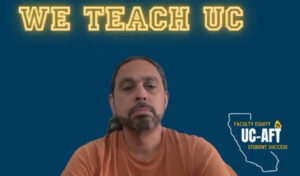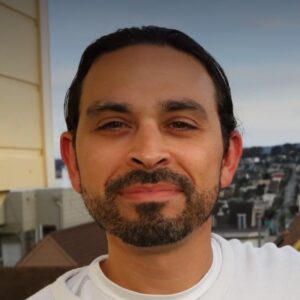
For our first UC-AFT Member Spotlight, we are proud to recognize Dr. Michael Calderon-Zaks, a Continuing Lecturer in Sociology at UC San Diego, longtime UC-AFT member, and former Chair of UC-AFT’s Anti-Racism Committee.
Michael recently received a teaching award from the American Sociological Association’s Political Economy of the World-System’s Distinguished Teaching Award, a recognition that carries particular significance given the path he has traveled as a lecturer. Before arriving at UC San Diego, Michael taught across numerous UC campuses, CSUs, and community colleges, often working part-time and on short-term contracts.
For Michael, the award recognizes not only his own teaching but also the often-unrecognized excellence of contingent faculty. Lecturer faculty, he points out, carry an enormous responsibility for undergraduate teaching while continuing to experience employment insecurity. Even extraordinary teaching does not necessarily translate into economic security. In fact, Michael received the award during the same period in which the loss of summer teaching reduced his annual teaching income significantly.
That tension—between the value of our work and the conditions under which we perform it—runs throughout Michael’s story.
At the center of his teaching are his students. Michael wants them to leave his sociology courses able to apply what they learn to their everyday lives and to better understand people whose experiences differ from their own. He asks students to recognize that leadership doesn’t necessarily mean becoming a politician or holding a prestigious title. They will lead families, classrooms, workplaces, and institutions. He hopes they will do so ethically and with particular attention to those who are most vulnerable.
That same commitment led Michael to UC-AFT’s Anti-Racism Committee. As chair, he worked to revitalize the committee and advocate for greater participation and transparency within the union. For Michael, racial justice cannot be separated from disability justice, economic justice, or labor justice. They intersect in the question of who gets to participate, whose voices are heard, and who has access to decision-making.
His experience during UC-AFT’s previous contract campaign reinforced that conviction. When bargaining moved online during the pandemic, hundreds of lecturers could participate without traveling across the state. Michael remembers the Zoom chat becoming something unexpected: a place where lecturers who often did not even know colleagues on their own campuses began finding one another.
“We got to know each other,” he recalled. More importantly, members began to see who would speak up—and to recognize their collective power.
His message to members who are not yet involved in UC-AFT is simple: ask questions and find a way to participate. The union, he argues, has a responsibility to answer those questions and create meaningful avenues for involvement.
Michael closed our conversation with a reminder that captures the spirit of this new Member Spotlight series: lecturer experiences are not all the same. Race, gender, disability, economic circumstances, and other differences shape how academic labor is experienced.
Teaching, racial justice, labor justice, and solidarity, he reminds us, are “all connected in ways that we don’t always recognize.”